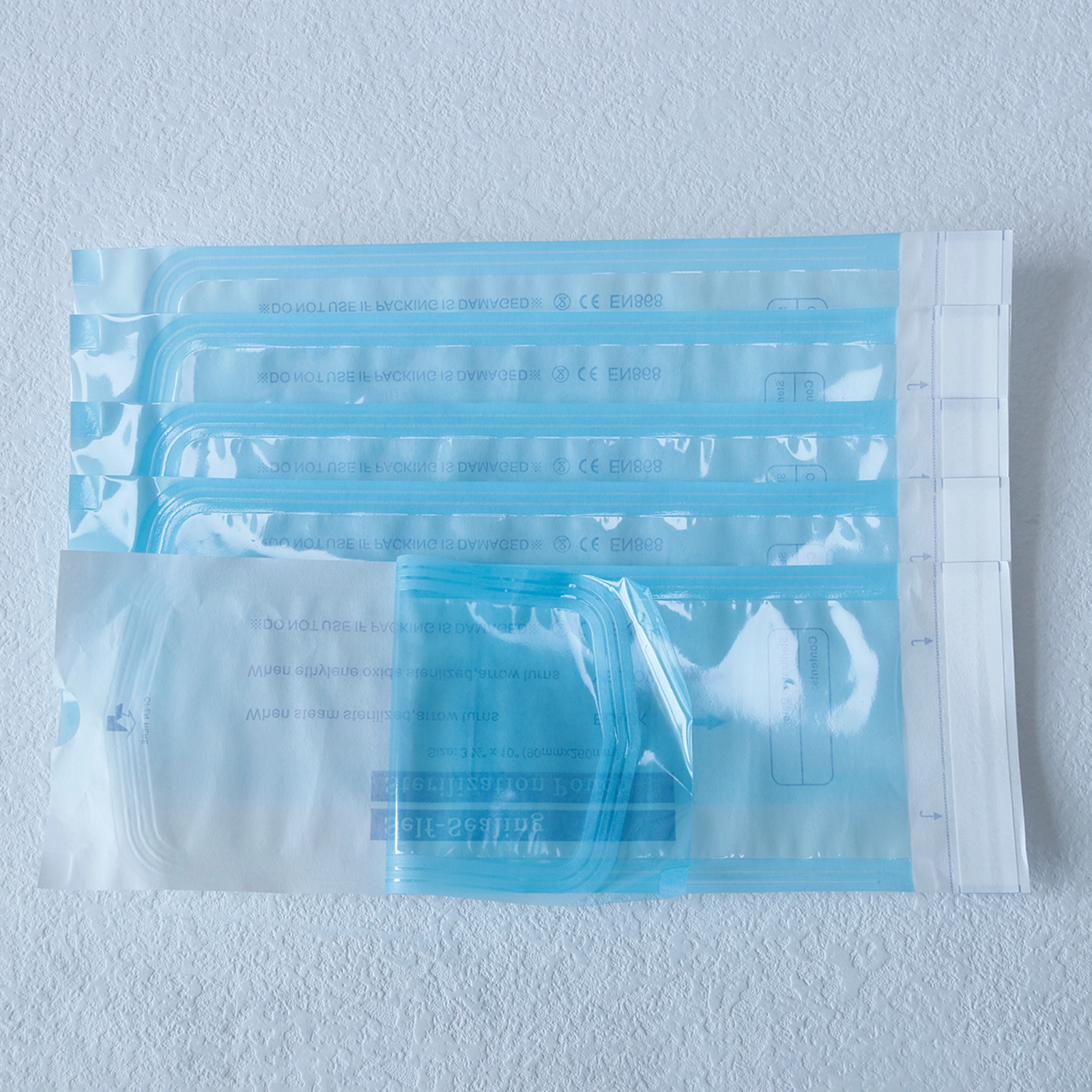
The Importance of Chemical Indicators in Sterilization Pouches: Reading the Signs
Release time: 2026-04-20
Table of Contents
In the critical field of infection control, assuming an instrument is sterile just because it went through an autoclave is a dangerous gamble. Machine malfunctions, overloading, and incorrect packaging can all prevent sterilants from effectively reaching the instruments. This is where sterilization indicators become the frontline defense against hospital-acquired infections (HAIs) and cross-contamination.
Chemical Indicators (CIs) printed on or placed inside sterilization pouches provide immediate, visual confirmation that specific sterilization parameters have been met. For CSSD (Central Sterile Services Department) technicians and dental professionals, correctly “reading the signs” is a non-negotiable daily task.
This guide breaks down the science behind indicator color changes, explains the critical difference between internal vs external indicators, and decodes the ISO classification system from Class 1 to Class 6.

How Chemical Indicators Work: The Science of Color Change
Chemical indicators utilize specialized, reactive inks that undergo a chemical and visual transformation when exposed to specific sterilization variables—typically heat, time, pressure, or sterilant gas concentration (like Steam or EO).
These are not simply temperature-sensitive dyes; they are highly engineered chemical formulations designed to react only when a specific threshold of multiple variables is achieved.
Common Visual Transformations:
- Steam Autoclave: Often transitions from Pink to dark Brown or Black.
- Ethylene Oxide (EO): Frequently shifts from Red/Pink to Yellow or Green.
- Plasma ($H_2O_2$): Typically changes from Blue or Purple to Pink or Red.
Note: Color changes can vary slightly by manufacturer, so always refer to the specific color reference guide provided on your packaging.
Internal vs External Indicators: Securing the Sterile Barrier
A robust sterilization protocol relies on a two-tier verification system using both internal and external indicators. Understanding the distinct roles of internal vs external indicators is vital for quality assurance.
External Indicators (Process Indicators)
External indicators are printed directly on the outside of sterilization pouches or applied via indicator tape.
- Purpose: They provide at-a-glance confirmation that a package has been exposed to the sterilization process.
- Limitation: They do not guarantee the instruments inside are sterile; they merely differentiate processed packages from unprocessed ones, preventing accidental use of unsterilized tools.
Internal Indicators (Penetration Indicators)
Internal indicators are multi-variable or integrating strips placed inside the pouch alongside the instruments before sealing.
- Purpose: They prove that the sterilizing agent (steam, gas, etc.) successfully penetrated the packaging barrier and reached the instruments themselves for the required duration and temperature.
- Importance: If a pouch is packed too tightly, the external indicator may turn black (confirming machine exposure), but the internal indicator will fail to change color, alerting the technician that the load was compromised and must be reprocessed.
Decoding the Classes: Class 1 to Class 6 Indicators Explained
To standardize infection control globally, the International Organization for Standardization (ISO 11140-1) categorizes chemical indicators into six distinct classes (often referred to as “Types”). Each class serves a specific, escalating verification purpose.
Class 1: Process Indicators
These are the most basic indicators, primarily functioning as external indicators.
- Application: Autoclave tape, indicator dots, and the reactive ink printed on the outside of standard medical paper pouches.
- Function: Simply confirms exposure to the sterilization process to separate processed from unprocessed items.
Class 2: Specific-Use Indicators
These are not used for routine pouch monitoring. Instead, they are used for specific machine diagnostic tests.
- Application: The Bowie-Dick Test.
- Function: Tests the efficacy of the vacuum system in pre-vacuum steam sterilizers to ensure all air is removed so steam can fully penetrate.
Class 3: Single-Variable Indicators
These indicators are designed to react to only one critical sterilization variable.
- Application: Internal monitoring (though largely phased out in modern, rigorous CSSDs).
- Function: For example, a Class 3 indicator might only measure temperature (melting at 121°C), ignoring the “time” factor completely.
Class 4: Multi-Variable Indicators
A significant step up for internal monitoring, Class 4 indicators react to two or more critical variables.
- Application: Internal pouch strips.
- Function: They confirm that both specific parameters (e.g., a temperature of 134°C AND an exposure time of 3 minutes) have been met inside the pouch.
Class 5: Integrating Indicators
Class 5 indicators are highly advanced and are designed to react to all critical variables of the sterilization cycle.
- Application: Internal monitoring for high-risk loads or implantable devices.
- Function: Their performance is calibrated to parallel the response of Biological Indicators (BIs), meaning if a Class 5 indicator passes, there is a very high statistical probability that the biological spores are also dead. They provide an immense level of safety assurance.
Class 6: Emulating Indicators (Cycle-Specific)
Class 6 indicators are the most precise and stringent chemical indicators available, engineered for one very specific cycle profile.
- Application: Internal monitoring for specialized cycles.
- Function: Unlike Class 5, which covers a range of cycles, a Class 6 indicator is cycle-specific (e.g., exactly 134°C for exactly 3.5 minutes). If the cycle falls short by even a fraction, the indicator will instantly fail.
Partnering for Compliance and Safety
At AnQing Clean Dental Instrument Technology Co., Ltd., we know that the safety of healthcare professionals and patients relies on unmistakable accuracy. That is why our sterilization pouches are manufactured with high-fidelity, non-toxic, water-based Class 1 process indicator inks that provide sharp, unambiguous color changes.
Furthermore, our pouches are engineered to accommodate the seamless insertion of Class 4, 5, or 6 internal indicators without compromising seal integrity or creating blind spots. By choosing Clean Dental Instrument you are ensuring that your clients have the reliable, compliant packaging necessary to interpret sterilization signs with absolute confidence.
Frequently Asked Questions (FAQ)
Q: What does it mean if the internal indicator changes color, but the external indicator does not?
A: This is a rare occurrence often pointing to a manufacturing defect in the pouch’s external ink, or an incorrect indicator type being used for the specific sterilizer. In any event where indicators show conflicting or incomplete color changes, the load must be considered unsterile and reprocessed.
Q: Are the indicator inks on sterilization pouches toxic?
A: High-quality pouches manufactured by reputable suppliers utilize non-toxic, water-based inks. This ensures that the chemical reaction does not off-gas harmful substances onto the medical instruments during the intense heat of the sterilization cycle.
Q: Can a Class 6 indicator replace a Biological Indicator (BI)?
A: No. While Class 5 and Class 6 indicators provide highly accurate, immediate chemical verification that cycle parameters were met, Biological Indicators (spore tests) remain the ultimate proof of lethality by verifying the actual destruction of living microorganisms.
Q: Why do some sterilization pouches have multiple indicators printed on the outside?
A: Many modern pouches feature multi-parameter process printing (e.g., both Steam and EO indicators on the same pouch). This adds versatility, allowing the same inventory to be used safely across different sterilization departments while ensuring the correct visual cue is provided for the chosen method.